
Parāoa Sighted in the Ross Sea Region Marine Protected Area
Story by Dr Regina Eisert, 10 February 2023
Today we are approaching the Balleny Islands. Located approximately 325 km north of the Antarctic Continent between 66° 15’S and 67° 10’S and 162° 15’E and 164° 45’E.
The Balleny Island Archipelago lies within the main Antarctic Circumpolar Current and attracts an exceptional abundance of wildlife. One of its islands has been designated as a Antarctic Specially Protected Area (ASPA) on the basis of its outstanding ecological value, and the entire archipelago is part of the Ross Sea Region Marine Protected Area.
Near the northern end of the archipelago lies the Balleny Seamount (see map below).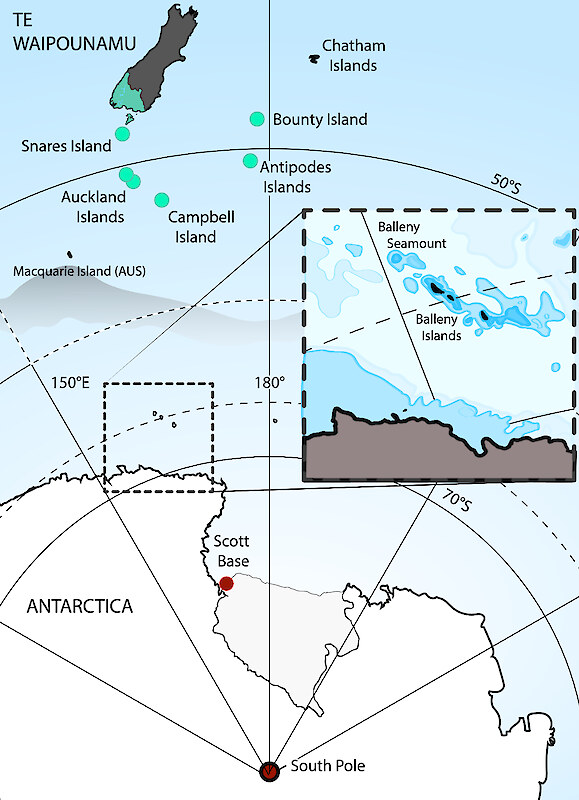 The Balleny Seamount in relation to the Balleny Islands and the Antarctic Continent. © Dr Regina Eisert. It is this seamount that the ship is now approaching. We hope to spot whales that visit the area to take advantage of its exceptional marine productivity.
Right on cue, we see several groups of feeding paikea (humpback whales Megaptera novaeangliae) 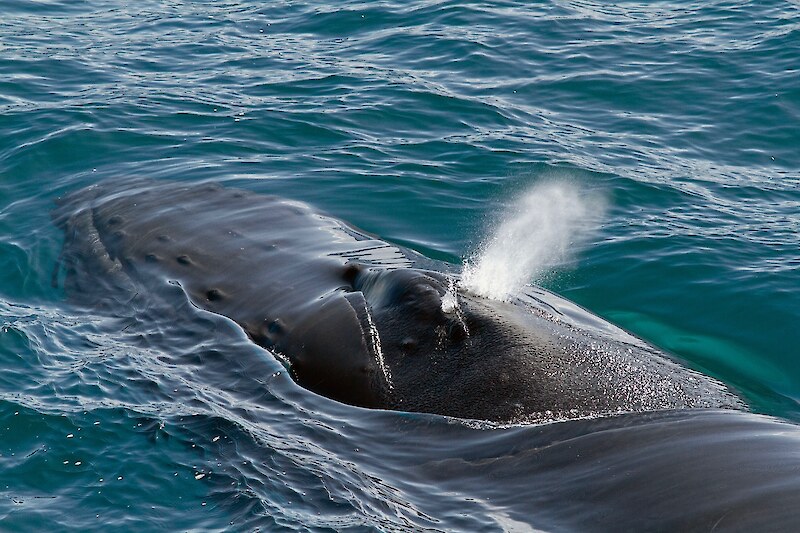 A close-up of a curious paikea (Megaptera novaeangliae) visiting our ship. As baleen whales, paikea have paired blowholes, whereas toothed whales (including parāoa and kākahi) breathe through a single blowhole. © Dr Regina Eisert.surrounded by cape petrels (Daption capense), blue petrels
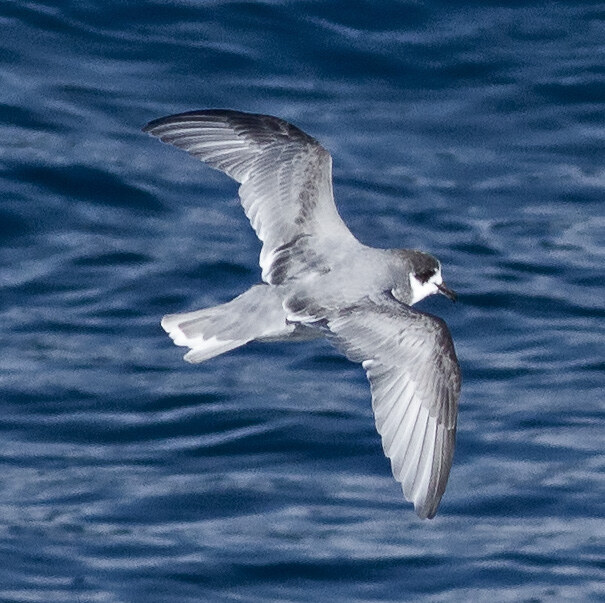 A blue petrel (Halobaenus caeruleus), one of the many species of seabird found in the Southern Ocean. © Dr Regina Eisert. (Halobaena caerulea), giant petrels (Macronectes giganteus), and tītī (Puffinus griseus), a surprising sight so far south. The Captain stops the engines. To our delight, curious paikea crowd around the ship, surfacing so close to us that we hear them breathe and see the barnacles that mark the skin of their backs.
Eagle-eyed Heritage Expedition staff Agnès and Kate spot a very special whale that is keeping its distance from the fray: a parāoa (sperm whale, Physeter macrocephalus), largest of the toothed whales. While it is common for large whale species in both hemispheres to migrate to polar regions for the summer to feed, among parāoa only mature males—who can reach up to 18 m in length—make the seasonal commute to the polar oceans. Female sperm whales, comparatively small at 9‑13 m mature length, remain at lower latitudes with their young, until the young males leave to join their brothers.
Whaling ships hunting parāoa and other whales came to New Zealand and the Ross Sea region first from America and Europe, and later from Japan and Russia. Parāoa were valued for their size and the spermaceti ‘oil’ (in fact a type of wax ester) extracted from their heads. Their populations were decimated like those of the other large whales.
Unlike paikea and other baleen whales, who are filter feeders and scoop up krill and small fish near the surface, parāoa can dive to great depth (>2,000 m) and hunt for giant squid and other deep-see creatures. The first specimens of Antarctic toothfish (Dissostichus mawsoni) were found in the stomach of parāoa by biologists working in the Soviet whaling fleet, suggesting that toothfish are an important prey item for these whales.
Male parāoa are frequently seen off the coast of Murihiku, to the west of Te Awa a Kiwa, around Jackson Bay on the West Coast, and of course at Kaikōura. In the Ross Sea region, male parāoa have been seen as far south as 72° S but most sightings are from the Balleny Islands and along the slope of the continental shelf that marks the border of the Ross Sea proper. It has been hypothesised that New Zealand parāoa travel to the Ross Sea region to feed in the summer, but there is no evidence to confirm this so far.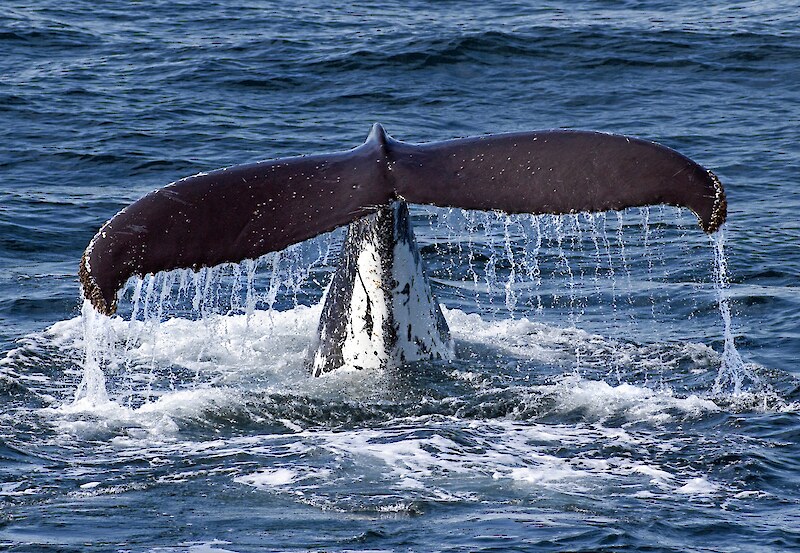 The fluke of a paikea. Paikea have light bellies and the underside of their tail fluke is also pale, while parāoa are a uniform dark colour. © Dr Regina Eisert.
The question is, did the whale we saw today come here from Te Waipounamou? The images captured by Agnès and Kate can provide the answer. The overall shape of the fluke and in particular the pattern of notches in the trailing edge are unique to each whale and can be used to identify individuals, a method known as photo-identification or photo-ID for short. All we need to do is to compare the photo of our mystery whale from the Balleny Seamount with photos of parāoa taken in New Zealand. Or perhaps this whale came from even further afield? Something to figure out once we are back from our expedition.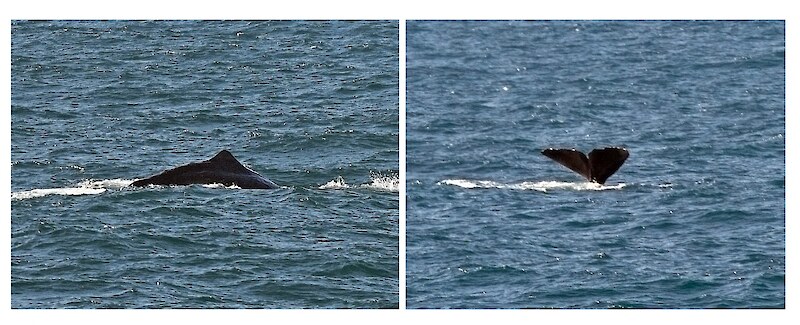 Left: The parāoa’s back showing the characteristic wrinkled skin, dorsal ridge, and small, triangular dorsal fin. © Kate Sutherland. Right: Parāoa show their tail fluke before diving. The shape and pattern of notches on the trailing edge of the fluke are unique and can be used to identify individual whales. This will allow us to track whales travelling between New Zealand and the Southern Ocean. © Agnès Brenière.
Posted: 27 February 2023