
Murihiku Regeneration’s Southern Ocean - Murihiku ki te Tonga project is about understanding, protecting, and sustainably managing the Southern Ocean - from Murihiku to Antarctica.
Globally there is a rising awareness that indigenous knowledge and indigenous leadership are essential for understanding, protecting, and sustainably managing the ocean.
Purpose
Ngāi Tahu ki Murihiku leads research and monitoring of the ocean from Murihiku to Antarctica for effective protection and management of Te Taiao Moana and for the benefit of our region, our country, and the World.
Context
Te Moana Tāpokopoko a Tāwhaki and Te Tiri o Te Moana (the ocean south of Murihiku and Antarctica) are home and hunting grounds for many iconic species and represents one of the least impacted marine environments on Earth. At the same time, there is rising pressure to exploit marine resources through fishing, aquaculture, mining, and as a source of energy.
In the Pacific, whales, seabirds, and other marine keystone species migrate seasonally from the tropics to temperate and polar latitudes, some as far as Antarctica. This living web spans the entire Pacific Hemisphere and effectively functions as a dynamic sensor network for climate and marine productivity.
Beyond its significance as an ecosystem, the Southern Ocean is essential for understanding, anticipating, and coping with climate change.
Closer to home, the development of marine energy such as offshore wind and wave energy in Murihiku requires a deep understanding of the ocean to achieve a balance that respects the environment and permits sustainable use.
Subantarctic Islands
The New Zealand Subantarctic Islands consist of five island groups south-east of Te Waipounamu:
- Tini Heke - Snares Islands: about 100km southwest of Stewart Island/Rakiura
- Hauriri - Bounty Islands: about 700km east-south-east of Te Wai Pounamu
- Moutere Māhue - Antipodes Islands: about 860km southeast of Stewart Island/Rakiura
- Moutere Ihupuku - Campbell Island: about 700km south of Te Wai Pounamu and 270km southeast of Auckland Island.
- Maungahuka - Auckland Islands: about 465 south of Bluff
Archaeological evidence indicates that Polynesian explorers and their dogs were present in the Auckland Islands as early as the 13th-14th Century AD.
World Heritage Status
The Subantarctic Islands are located on the boundaries between two ocean fronts, and support outstanding biodiversity. The island groups and marine environment out to 12 nautical miles have UNESCO World Heritage status.
Together with Macquarie Island, the New Zealand Subantarctic Islands are a plant biodiversity hotspot and, with around 35 endemic taxa (found nowhere else in the world), have the richest flora of all the subantarctic islands that surround the Antarctic continent.
A large number and diversity of seabirds and penguins nest in the islands, with 126 bird species in total, including 40 seabirds of which five breed nowhere else in the world.
The islands are home to endangered rāpoka (New Zealand sea lions) as well as several million tītī (muttonbirds). At least twelve of the 18 penguin species worldwide occur in the Ross Sea Sector.
In winter and spring, tohorā (southern right whales) congregate in the waters around Maungahuka and Moutere Ihupuku to breed.
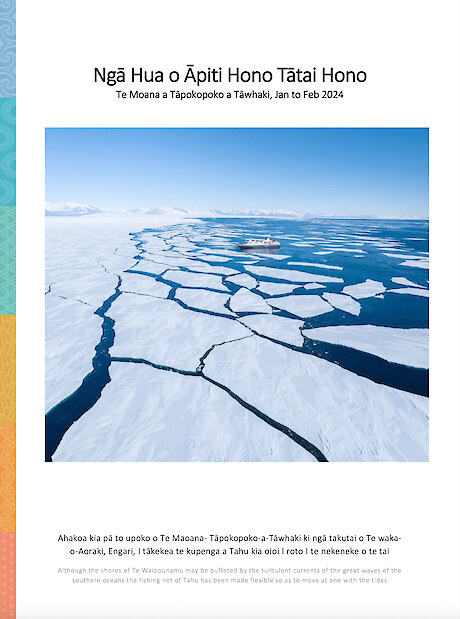 Āpiti Hono Tātai Hono
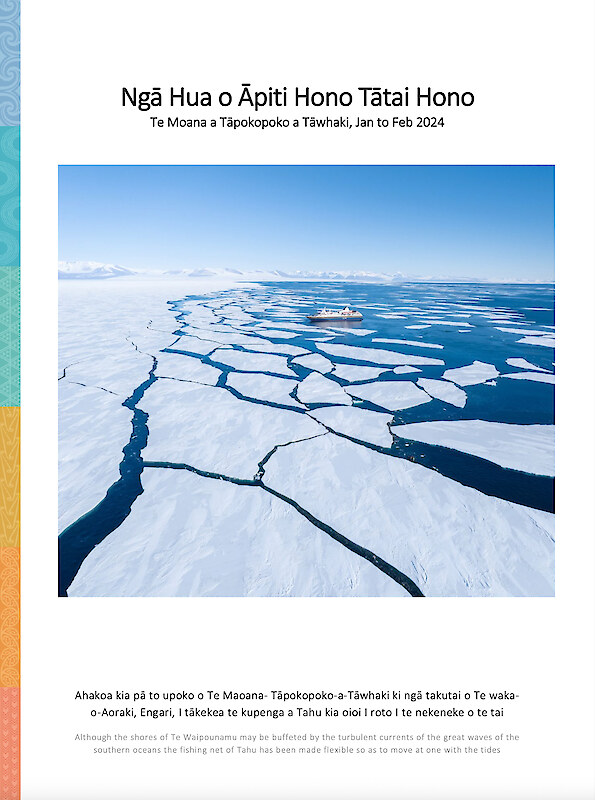
In 2024 Murihiku Regeneration undertook an Āpiti Hono Tātai Hono assessment to guide the various kaupapa that they are engaging with in the Southern Ocean Te Moana a Tāpokopoko a Tāwhaki. This assessment provides information on the associations and connections manawhenua have with Te Moana a Tāpokopoko a Tāwhaki, Snares, Auckland, Campbell, and Macquarie islands, and Antarctica. It provides direction on what types of activities may or may not be appropriate in this area, based on the tikanga, kawa and mātauranga of Ngāi Tahu ki Murihiku.
Ngā Hua o Āpiti Hono Tātai Hono (the fruits or results of Āpiti Hono Tātai Hono), is the publicly available report; a combination of Āpiti Hono Tātai Hono assessments with site visits, and other matters (including written references) that whānau have deemed relevant in their consideration of Te Moana a Tāpokopoko a Tāwhaki.
Download: Ngā Hua o Āpiti Hono Tātai Hono - assessment for the Southern Ocean.
Methodology
The methodology of the Āpiti Hono Tātai Hono is outlined in Āpiti Hono Tātai Hono: Ngā Whenua o Ngāi Tahu ki Murihiku Stage 1 Southland Cultural Landscape Assessment Study, 2021.In Murihiku, Ngāi Tahu have developed Āpiti Hono Tātai Hono to assess and consider what is held within a land or seascape, drawing their understanding from whakapapa, mana, kawa, tikanga, mātauranga, identity, connections, practices, history, and future aspirations. These considerations are the context in which to determine what is appropriate at place and the relationships Ngāi Tahu ki Murihiku have with their whenua and moana.
This assessment methodology was designed ‘by Ngāi Tahu, for Ngāi Tahu’, and was formalised by Ngāi Tahu ki Murihiku in 2021 with the support of the four Southland local authorities. Āpiti Hono Tātai Hono is Ngāi Tahu ki Murihiku designed and owned. While its origins are very old, the use of Āpiti Hono Tātai Hono in this way is modern, and Ngāi Tahu ki Murihiku is now transitioning to using Āpiti Hono Tātai Hono as part of its decision making, including for resource consent proposals in its takiwā.
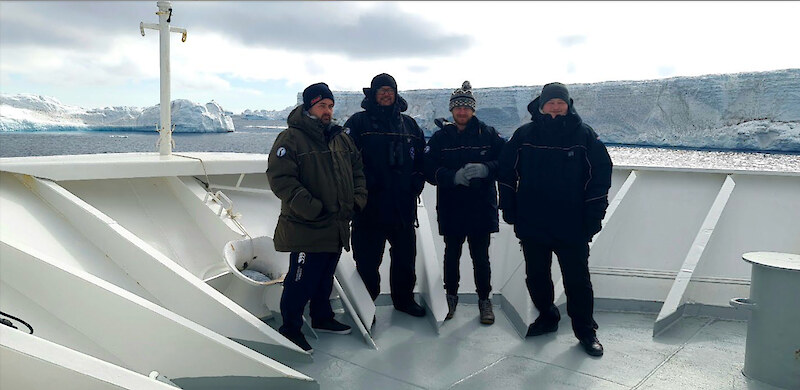 Karlee Nicholas, Riki Parata, Luka Whaitiri-Finn, Tāne Tāmati on a month-long Southern Ocean science and research expedition as a part of the Murihiku Regeneration ki te Tonga Programme, aboard the Heritage Adventurer, 2024.