
Hokonui Rūnanga Register
  • About us
    • Who we are
    • Murihiku Regeneration
    • Property assets
    • Find us
    • Job vacancies
  • Our history
    • Our whakapapa - a deep connection to this place
    • Wai and Whakapapa
    • The Battle of Waitaramea
    • Poupoutunoa and Kauwaewhakatoro
    • Two Rivers: Mataura (Mata Ura) and Clutha (Mata Au)
  • Events & key dates
    • He Ao Hou - New Futures Murihiku Teacher PD Day
    • Energy and Innovation Wānanga 2024
    • Energy and Innovation Expo 2023
    • Science and Innovation Wānanga 2021
    • Energy, Infrastructure and Opportunities Wānanga 2026
  • Education & training
    • Education - Hokonui Rohe Team
    • Te Ara Aukati Kore - Education, Training, and Capability
    • Have your say!
  • Environment
    • Kaupapa Taiao - Hokonui Floriculture
    • Taonga Research
    • Southern Ocean - Murihiku ki te Tonga
    • Energy Transition Programme
    • Te Tapu o Tāne
    • Our Kaimahi - Staff
  • Health & wellbeing
    • Whānau Ora Navigators
    • Community youth worker and advocacy service
    • Hokonui Community-Led Health
    • Kaumatua Health Days
    • Te Kakano - Nurse-led Clinics
    • Our Kaimahi - Staff
    • Hokonui Takiwā Health and Wellbeing Village of Support
    • Referral form
    • COVID-19
  • News
    • Pānui updates
    • Photos
  • Contact us
    • Register
  1. Home
  2. News
  3. Murihiku Team Continues Killer Whale Research Programme

News article

Murihiku Team Continues Killer Whale Research Programme
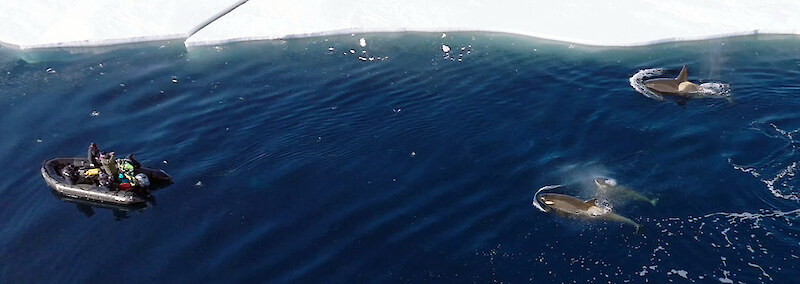
Curious Antarctic Type-C killer whales head towards the Murihiku zodiac (far left) to have a look at their visitors. Photo: Colin AitchisonCurious Antarctic Type-C killer whales head towards the Murihiku zodiac (far left) to have a look at their visitors. Photo: Colin Aitchison

Kākahi-killer whales hunt prey as varied as fish, penguins, seals, and minke whales, and are the top predators of the ocean. The fish-eating Type-C Antarctic killer whale (TCKW) is a designated focal species for research in the Ross Sea Region Marine Protected Area (MPA). The reason for this special attention is that the Ross Sea fishery is potentially competing with TCKW for Antarctic toothfish (Dissostichus mawsoni), a large, high-fat fish thought to be a favourite food for killer whales, Weddell seals, and parāoa in the Ross Sea region.
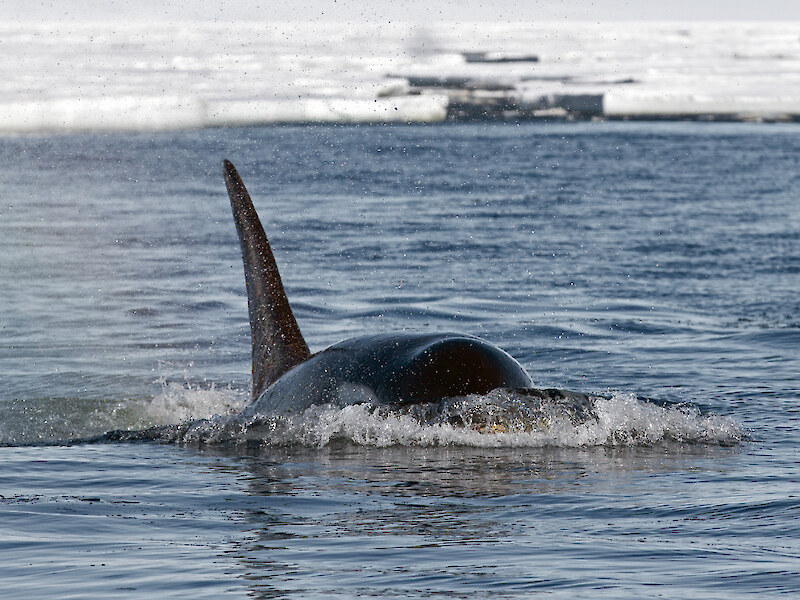
Operating in a zodiac provided by Heritage Expeditions, the Murihiku Team had the opportunity to come face to face with the killer whales like this magnificent adult male. Photo: Regina EisertOperating in a zodiac provided by Heritage Expeditions, the Murihiku Team had the opportunity to come face to face with the killer whales like this magnificent adult male. Photo: Regina Eisert

Following the retreating sea ice south on the Heritage Adventurer, this week the Murihiku Expedition team reached McMurdo Sound, a known hotspot for Antarctic killer whales (Orcinus orca). In 2013, Murihiku ki Te Tonga Science Lead Dr Regina Eisert started the first Antarctic killer whale research programme in and for the Ross Sea region MPA to find out what the whales eat, how many there are, and how and when they move between the Ross Sea and New Zealand. To find out, killer whales are photographed to uniquely identify individuals (photo-ID), and their behaviour is observed from the air and with underwater cameras. Photo-ID allows tracking of whale movements when they are re-sighted in New Zealand waters or as far north as Australia.
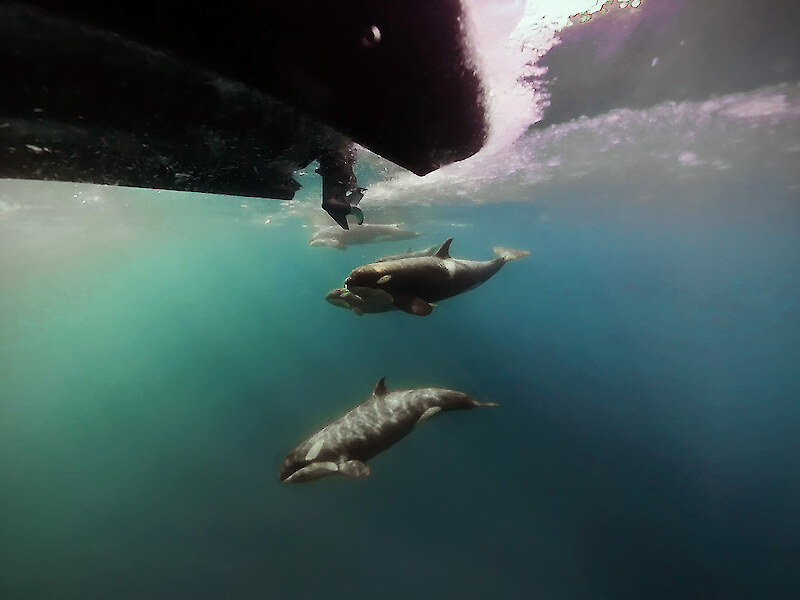
As part of the scientific research programme, killer whales are filmed underwater. Here they are having a closer look at the underside of the zodiac. Photo: Murihiku ki Te TongaAs part of the scientific research programme, killer whales are filmed underwater. Here they are having a closer look at the underside of the zodiac. Photo: Murihiku ki Te Tonga

Field work on the Ross Sea killer whales was interrupted in 2020, but the programme was successfully re-launched during the inaugural Murihiku ki Te Tonga expedition in February 2023. Zodiac support provided by Heritage Expeditions allowed the Murihiku Team to move effortlessly among the ice floes and study the whales up close using underwater video and a small drone.

Although it is not clear who studied whom, as one group of whales after another made a beeline for the zodiac and gave it a thorough inspection. Access to boat support is a new capability for the Antarctic killer whale research programme and gives a fantastic boost to the scientific work.
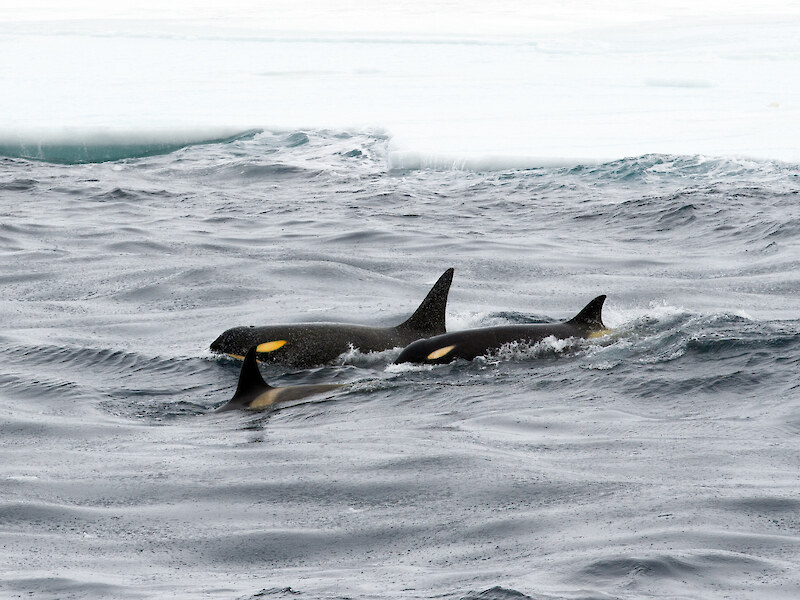
Type-C killer whales are distinguished from other killer whales by their distinctive narrow, upward-sloping eye patches. This type is at home in the icy waters of the southern Ross Sea but also visits New Zealand. Photo: Regina EisertType-C killer whales are distinguished from other killer whales by their distinctive narrow, upward-sloping eye patches. This type is at home in the icy waters of the southern Ross Sea but also visits New Zealand. Photo: Regina Eisert

Posted: 27 January 2024

Prev article
All articles
Next article
  • News
    • Pānui updates
    • Photos

© 2026 Hokonui Rūnanga • Website by RS

Facebook
  • Home
  • About us
    • Who we are
    • Murihiku Regeneration
      • Structure and context
      • Office of Upoko
    • Property assets
    • Find us
    • Job vacancies
  • Our history
    • Our whakapapa - a deep connection to this place
    • Wai and Whakapapa
    • The Battle of Waitaramea
    • Poupoutunoa and Kauwaewhakatoro
    • Two Rivers: Mataura (Mata Ura) and Clutha (Mata Au)
      • Mata Ura - Mataura River
      • Mata Au - Clutha River
  • Events & key dates
    • He Ao Hou - New Futures Murihiku Teacher PD Day
    • Energy and Innovation Wānanga 2024
    • Energy and Innovation Expo 2023
      • He Ao Hou - New Futures Murihiku 22 May
      • Live Streaming of Wānanga 23 and 24 May
      • Hosts and Key Speakers 23-24 May
      • Energy and Innovation presentations - 23 May
        • Opening Addresses
        • Global Session
        • Empowering partnerships: government's role in Aotearoa's energy transition
        • Climate Economics
        • Regional Infrastructure
        • Social regeneration and innovation
        • Regional Innovation
        • The importance of the Māori economy through this change
      • Energy and Innovation presentations - 24 May
        • Regional Leadership Panel
        • Regional Plans and Priorities
        • Southern Green Hydrogen
        • Tiwai Smelter Future
        • Southland Aquaculture
        • Regional Case Studies: Decarbonisation
        • Innovation and Bluff Re-imagining
        • Confirming Priorities: wrap-up and closing
    • Science and Innovation Wānanga 2021
    • Energy, Infrastructure and Opportunities Wānanga 2026
  • Education & training
    • Education - Hokonui Rohe Team
    • Te Ara Aukati Kore - Education, Training, and Capability
      • Kia Tū Pathway Planning Programme
        • Kia Tū in schools
        • Kia Tū Tertiary Pathway Programme
        • Meet Your Kaiako - SIT Campus
      • Anamata Māia: Bold, Confident Futures Service
        • Our Kaimahi - Staff
      • Penapena Ā Kura: School Attendance Service
      • Te Aka Whai Mahi: Find Your Path
      • He Ao Hou: New Futures Murihiku
    • Have your say!
  • Environment
    • Kaupapa Taiao - Hokonui Floriculture
    • Taonga Research
      • Kanakana Research
      • Our research partners
    • Southern Ocean - Murihiku ki te Tonga
    • Energy Transition Programme
      • Regional Energy Action Plan - Towards 2030
      • Energy Transition Plan for Murihiku-Southland
      • Hydrogen and Green Energy
      • Tiwai Point
    • Te Tapu o Tāne
    • Our Kaimahi - Staff
  • Health & wellbeing
    • Whānau Ora Navigators
    • Community youth worker and advocacy service
    • Hokonui Community-Led Health
    • Kaumatua Health Days
    • Te Kakano - Nurse-led Clinics
    • Our Kaimahi - Staff
    • Hokonui Takiwā Health and Wellbeing Village of Support
    • Referral form
    • COVID-19
  • News
    • Pānui updates
    • Photos
  • Contact us
    • Register
  • Facebook
  • Search...