
Hokonui Rūnanga Register
  • About us
    • Who we are
    • Murihiku Regeneration
    • Property assets
    • Find us
    • Job vacancies
  • Our history
    • Our whakapapa - a deep connection to this place
    • Wai and Whakapapa
    • The Battle of Waitaramea
    • Poupoutunoa and Kauwaewhakatoro
    • Two Rivers: Mataura (Mata Ura) and Clutha (Mata Au)
  • Events & key dates
    • He Ao Hou - New Futures Murihiku Teacher PD Day
    • Energy and Innovation Wānanga 2024
    • Energy and Innovation Expo 2023
    • Science and Innovation Wānanga 2021
    • Energy, Infrastructure and Opportunities Wānanga 2026
  • Education & training
    • Education - Hokonui Rohe Team
    • Te Ara Aukati Kore - Education, Training, and Capability
    • Have your say!
  • Environment
    • Kaupapa Taiao - Hokonui Floriculture
    • Taonga Research
    • Southern Ocean - Murihiku ki te Tonga
    • Energy Transition Programme
    • Te Tapu o Tāne
    • Our Kaimahi - Staff
  • Health & wellbeing
    • Whānau Ora Navigators
    • Community youth worker and advocacy service
    • Hokonui Community-Led Health
    • Kaumatua Health Days
    • Te Kakano - Nurse-led Clinics
    • Our Kaimahi - Staff
    • Hokonui Takiwā Health and Wellbeing Village of Support
    • Referral form
    • COVID-19
  • News
    • Pānui updates
    • Photos
  • Contact us
    • Register
  1. Home
  2. News
  3. Kids’ plea to Environment Select Committee: “Don’t forget our river”

News article

Kids’ plea to Environment Select Committee: “Don’t forget our river”

Article written by Rachael Kelly. Republished from Stuff.

In what is thought to be a New Zealand first, school pupils have made a passionate plea to the Environment Select Committee, asking it to save the Waiau River that flows through their community.

Pupils from of Hauroko Valley Primary School and Waiau Area School in rural Southland travelled to Wellington to present their Kaitiaki Project to the Select Committee, alongside members of the Waiau Rivercare Group.
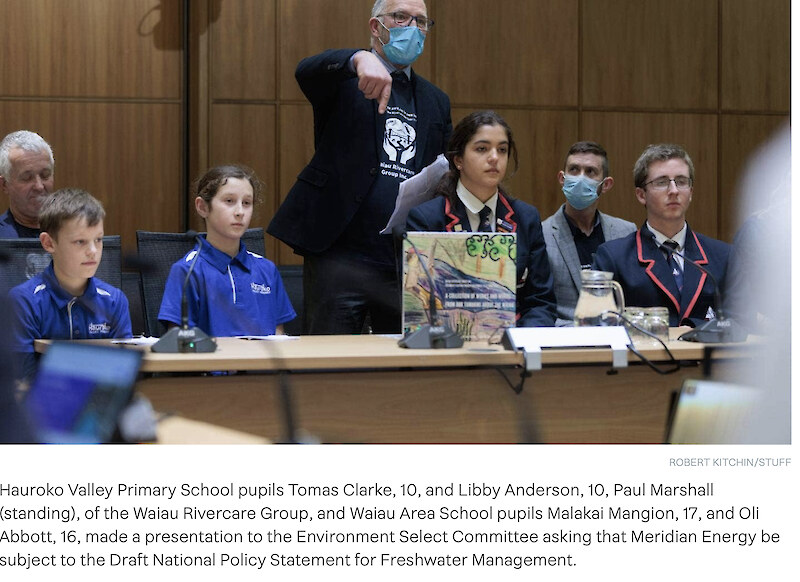
The group’s presentation asked that the House of Representatives urge the Government to remove the exception for the Manapōuri Power Scheme from the Draft National Policy Statement for Freshwater Management.

They want Meridian Energy to increase water flows in the Waiau River, instead of diverting it to the power scheme, to stop algal blooms and return the river to a state of ecological health.

Libby Anderson, 10, Tomas Clarke, 10, and their teacher Jen Templeton, of Hauroko Valley Primary School, and, Malakai Mangion, 17, Oli Abbott, 16, and their teacher Richard Bennett, of Waiau Area School, presented the project, an ecological inquiry by more than 120 children and young people sharing their thoughts, feelings and values for their river.

Libby told the committee that their community all love the Waiau River “but we’ve lost it, but we want it back”.

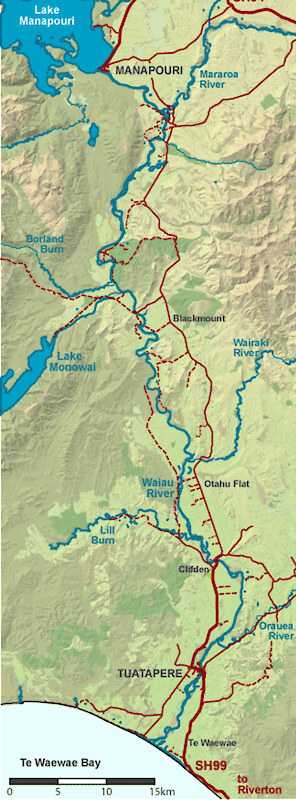
Malakai and Oli said the community all relied on the Waiau, but now the Waiau was relying on them.Map showing Waiau River - flowing from Lake Manapōuri to the coast (source: NZ Fishing).Map showing Waiau River - flowing from Lake Manapōuri to the coast (source: NZ Fishing).
“We, as the young people of the Waiau, cannot share the same carefree experiences that generations before us have. Today our relationship with the Waiau involves checking online for the swimmabilty rating of the river, reading didymo signage at the Tuatapere Domain, and smelling and seeing thick slimy sludge and other sign of bacteria suffocate the beating heart of our catchment,’’ they said.

Environment Select Committee chair Eugenie Sage thanked the group for the mahi that had gone into their Waiau taonga project, and their presentations, which she said were ‘’very compelling’’.

Under the Government’s package, the hydro-electric scheme, which generates power for the Tiwai Point aluminium smelter, would be exempt from freshwater management requirements to support renewable energy targets.

The Manapōuri Power Scheme, which is owned by Meridian Energy, removes water from the Waiau River catchment and discharges it to Deep Cove in Fiordland after it has been through the power scheme.

Earlier this month Waiau Rivercare Group co-chairman Paul Marshall said the power scheme takes 95% of the river’s flow, leaving the lower Waiau with 5% of what its flow used to be.

“The ongoing environmental, cultural and social effects are significant, and dire, and makes the Waiau unsafe to swim in. This exception removes our community’s voice for the Waiau River for the next 50 years. To be heard, hydro must not be exempt from the Policy Statement,’’ he said.

As well as presenting to the committee, the pupils had a private tour of parliament, seats in the public gallery, and use of the personal suite of the Speaker of the House, Trevor Mallard.

The group had to fundraise to get to Wellington, and also received a grant from the Parliamentary Travel Fund.

Posted: 30 July 2022

Prev article
All articles
Next article
  • News
    • Pānui updates
    • Photos

© 2026 Hokonui Rūnanga • Website by RS

Facebook
  • Home
  • About us
    • Who we are
    • Murihiku Regeneration
      • Structure and context
      • Office of Upoko
    • Property assets
    • Find us
    • Job vacancies
  • Our history
    • Our whakapapa - a deep connection to this place
    • Wai and Whakapapa
    • The Battle of Waitaramea
    • Poupoutunoa and Kauwaewhakatoro
    • Two Rivers: Mataura (Mata Ura) and Clutha (Mata Au)
      • Mata Ura - Mataura River
      • Mata Au - Clutha River
  • Events & key dates
    • He Ao Hou - New Futures Murihiku Teacher PD Day
    • Energy and Innovation Wānanga 2024
    • Energy and Innovation Expo 2023
      • He Ao Hou - New Futures Murihiku 22 May
      • Live Streaming of Wānanga 23 and 24 May
      • Hosts and Key Speakers 23-24 May
      • Energy and Innovation presentations - 23 May
        • Opening Addresses
        • Global Session
        • Empowering partnerships: government's role in Aotearoa's energy transition
        • Climate Economics
        • Regional Infrastructure
        • Social regeneration and innovation
        • Regional Innovation
        • The importance of the Māori economy through this change
      • Energy and Innovation presentations - 24 May
        • Regional Leadership Panel
        • Regional Plans and Priorities
        • Southern Green Hydrogen
        • Tiwai Smelter Future
        • Southland Aquaculture
        • Regional Case Studies: Decarbonisation
        • Innovation and Bluff Re-imagining
        • Confirming Priorities: wrap-up and closing
    • Science and Innovation Wānanga 2021
    • Energy, Infrastructure and Opportunities Wānanga 2026
  • Education & training
    • Education - Hokonui Rohe Team
    • Te Ara Aukati Kore - Education, Training, and Capability
      • Kia Tū Pathway Planning Programme
        • Kia Tū in schools
        • Kia Tū Tertiary Pathway Programme
        • Meet Your Kaiako - SIT Campus
      • Anamata Māia: Bold, Confident Futures Service
        • Our Kaimahi - Staff
      • Penapena Ā Kura: School Attendance Service
      • Te Aka Whai Mahi: Find Your Path
      • He Ao Hou: New Futures Murihiku
    • Have your say!
  • Environment
    • Kaupapa Taiao - Hokonui Floriculture
    • Taonga Research
      • Kanakana Research
      • Our research partners
    • Southern Ocean - Murihiku ki te Tonga
    • Energy Transition Programme
      • Regional Energy Action Plan - Towards 2030
      • Energy Transition Plan for Murihiku-Southland
      • Hydrogen and Green Energy
      • Tiwai Point
    • Te Tapu o Tāne
    • Our Kaimahi - Staff
  • Health & wellbeing
    • Whānau Ora Navigators
    • Community youth worker and advocacy service
    • Hokonui Community-Led Health
    • Kaumatua Health Days
    • Te Kakano - Nurse-led Clinics
    • Our Kaimahi - Staff
    • Hokonui Takiwā Health and Wellbeing Village of Support
    • Referral form
    • COVID-19
  • News
    • Pānui updates
    • Photos
  • Contact us
    • Register
  • Facebook
  • Search...