
Hokonui Rūnanga and Forest Hill Trust partnering to protect Ōtewao
By Libby Young
The Forest Hill Trust has been successful in their DOC Jobs for Nature Funding application in partnership with the Hokonui Rūnanga over 3 years. The Jobs for Nature initiative is in response to the economic downturn created by COVID-19, the government through the Department of Conservation is providing a stimulus package for ‘Jobs for Nature’.
Through this stimulus package the Forest Hill Community Trust, partnership with the Hokonui Rūnanga have significantly increased their preservation programme in Forest Hill.
In addition, to support this kaupapa, the Hokonui Rūnanga were also successful in the Lottery Environment and Heritage Grant which also contributes to capital costs which will go towards the costs of traps and bait over 3 years.
What is so important about Ōtewao?
Forest Hill, also known as Ōtewao or Te Ihupuni is located in Murihiku (Southland) just outside of Winton. It is a 600-hectare conservation area used for recreation by Winton Invercargill and wider Murihiku, containing popular walking tracks, picnic areas, and views over the Southland Plains.
Forest Hill is a remnant of New Zealand native bush reflecting wildlife that existed prior to the settlement of humans. It contains dramatic rock formations, a range of native hardwood trees, limestone caves with taonga skeletons, and the most diverse range of flora in the Southland Plains. Its intact canopy, threatened plant life, and birdlife makes it an invaluable rarity worthy of considerable time, effort, and care.
For the Hokonui Rūnanga, Ōtewao is also part of a much bigger narrative. It is said to be one of the three large waves that capsized the Takitimu waka at Te Waewae Bay, located on the Foveaux Strait coast, the others being (Heale Ridge), and Ōkākā (Hump Ridge).
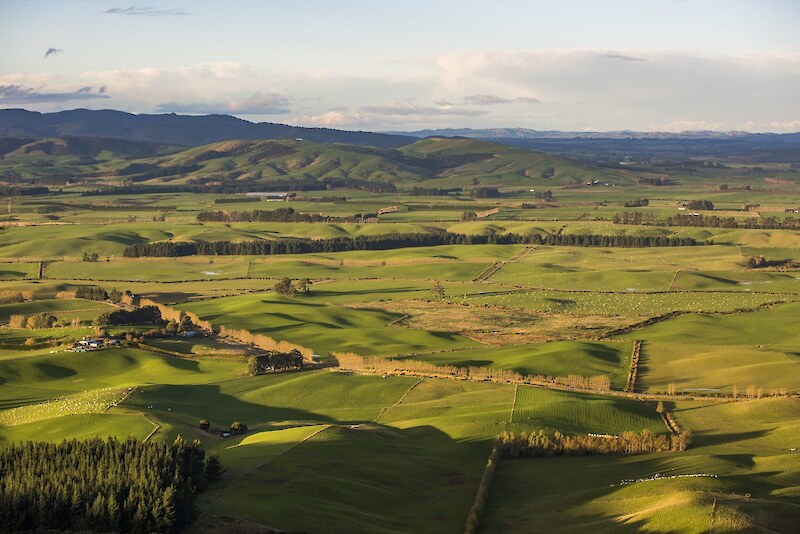 The view from the Forest Hill Reserve.
Groups involved
Although this project is being overseen and supported by the Hokonui Rūnanga, the progress being made in the area is largely due to the efforts of the Forest Hill Foundation Trust and project managers, Leith Contracting.
The idea of the Forest Hill Foundation Trust was born in 2002 and formally constituted in 2005. Their vision is to make Forest Hill an ecological island by “removing all introduced mammalian pests and predators from the Forest Hill Scenic Reserve and restoring the forest to a healthy diversity of indigenous fauna, many species of which have not been seen in the area in our lifetimes.” Originally The Trust was set on erecting a 15km predator free fence around the area, however unfortunately local landowners and financial barriers led the group to focus on intensive trapping of the reserve to keep pests at a manageable level. Nevertheless, The Trust still has aspirations of a predator-free fence in the future. Karalyn Twidle and Vincent Leith enjoying their hīkoi in the Forest Hill Reserve.
The Forest Hill Trusts’ achievements in monitoring and trapping predators, despite spasmodic funding, are worth significant celebration. By 2015 they had installed 400 bait stations to trap hedgehogs, cats, rats and mustelids. And, in 2020, via community funding efforts, The Trust started planting self-setting A24 traps to help prevent pests in the Northern block where a rare Wētā was discovered. Additional efforts include recording bird counts and completing an invertebrate study in the reserve. Their achievements were formally recognized by the 2018 Environment Southland award ceremony for “Environmental Action in the Community.” However, the greater reward was being informed by the many people who utilise the reserve that the birdlife is returning.
The Forest Hill Trust has always worked with Tony and Leith for pest control work as well as Rose Collen for monitoring. Leith Contractors have over thirty years of experience in pest control, with a significant experience in Hokonui and the Southern Plains where they whakapapa to. Vincent Leith the Managing Contractor started undertaking work at Forest Hill 10 years ago for DOC.
What they’re doing Forest Hill scenic reserve stoat trapping and infrastructure permission map.

The main intended outcome for the following 3 years is to enable ground-based possum, mustelid, and rat control by establishing effective trapping networks to prevent any pest reinvasions. A portion of this work is displayed on the Forest Hill scenic reserve stoat trapping and infrustructure permission map. This map also illustrates the extensive nature of the work being undertaken. Additionally, the team is also monitoring biodiversity and is in the process of improving habitats, with the deep-rooted aim of restoring absent taonga to Ōtewao.
The recent jobs for nature funding allows for a larger and more consistent impact. The more consistent application means these pest control methods serve a duo purpose. Not only to lower pest numbers but to prevent reinvasion in the first place. This has the additional benefit of being more cost-effective in the long term. What is more, trapping, unlike poison, is more favourable among the public and lets the Trust specifically monitor pest numbers and the success of pest eradication.
The impact
There are many added benefits of the biodiversity project in Forest Hill that are a part of a much larger picture. The project  Morepork chicks spotted at the Forest Hill Reserve.creates a number of jobs for tangata whenua, in an area especially hard-hit by the economic downturn caused by COVID-19. The experience allows for the upskilling of kaimahi and gives Murihiku a unique skill set to embrace the expected increase in environmental projects across Southland and Aotearoa in the future. This project, and others in the area like it, could one day be used as a benchmark for future projects, illustrating the high-quality conservation services that can be produced when applying a Ngai Tahu and te ao Māori focus. Most significantly, the project reconnects whenua to whānau and enhances Ngāi Tahu rangatiratanga and kiatiakitanga over their taonga species and whenua.
The original contract from the stimulus package is for three years, starting a year ago and expiring in two years. However, due to its success and continued importance, both Hokonui Rūnanga Kaupapa Taiao and The Trust have intentions of furthering work on Forest Hill long after this has run out. As stated by the Trust Chairperson Glenys Dickson, “The Forest Hill Foundation is extremely grateful to Hokonui Rūnanga for including Forest Hill Foundation Trust in their successful application to “Jobs for Nature” which has given us secure funding to control predators in the reserve under the professional management of Leith Contractors and we look forward to a close engagement and a positive future with the Hokonui Rūnanga.” These kind words are an expression the Hokonui Rūnanga Kaupapa Taiao shares.
Posted: 8 August 2022