Hokonui Rūnanga Register
  • About us
    • Who we are
    • Murihiku Regeneration
    • Property assets
    • Find us
    • Job vacancies
  • Our history
    • Our whakapapa - a deep connection to this place
    • Wai and Whakapapa
    • The Battle of Waitaramea
    • Poupoutunoa and Kauwaewhakatoro
    • Two Rivers: Mataura (Mata Ura) and Clutha (Mata Au)
  • Events & key dates
    • Energy, Infrastructure and Opportunities Wānanga 2026
    • Energy and Innovation Wānanga 2024
    • Energy and Innovation Expo 2023
    • Science and Innovation Wānanga 2021
    • He Ao Hou - New Futures Murihiku Teacher PD Day
  • Education & training
    • Education - Hokonui Rohe Team
    • Te Ara Aukati Kore - Education, Training, and Capability
    • Have your say!
  • Environment
    • Kaupapa Taiao - Hokonui Floriculture
    • Taonga Research
    • Southern Ocean - Murihiku ki te Tonga
    • Energy Transition Programme
    • Te Tapu o Tāne
    • Our Kaimahi - Staff
  • Health & wellbeing
    • Whānau Ora Navigators
    • Community youth worker and advocacy service
    • Hokonui Community-Led Health
    • Kaumatua Health Days
    • Te Kakano - Nurse-led Clinics
    • Our Kaimahi - Staff
    • Hokonui Takiwā Health and Wellbeing Village of Support
    • Referral form
    • COVID-19
  • News
    • Pānui updates
    • Photos
  • Contact us
    • Register
  1. Home
  2. News

News

South Island Principal Advisors - Secondary Transitions Visit Murihiku

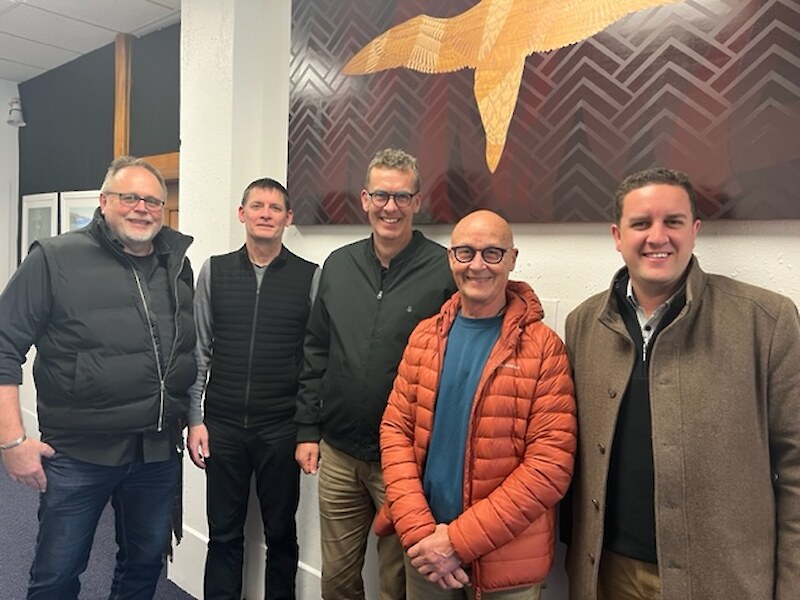
Ivan Hodgetts (Programme Lead, Te Ara Aukati and Ministry of Education Principal Advisor - Secondary Transitions) had the pleasure of hosting the other South Island Principal Advisors - Secondary Transitions last week.

The Ministry of Education Principal Advisors - Secondary Transitions (PAST), play a key role in working to enhance the pathways for rangatahi from school into the start of adult life and work. This includes a focus on achievement, retention and engagement in a purposeful pathway.South Island Ministry of Education Principal Advisors - Secondary Transitions. Left to right: Kerry Ryan, Ivan Hodgetts, Grant Ritchie, Jeff Lockhart and Joseph Houghton.South Island Ministry of Education Principal Advisors - Secondary Transitions. Left to right: Kerry Ryan, Ivan Hodgetts, Grant Ritchie, Jeff Lockhart and Joseph Houghton.

The South Island PASTs catch-up regularly to share thinking and experience. The visit to Invercargill provided an opportunity to find out more about the Murihiku Regeneration programme and how it will impact on future opportunities for the region’s rangatahi. Jeff Lockhart commented that:

“It was inspiring to hear about your work with Murihiku Regeneration and for you to share the aspirational goals and steps that you have planned, associated with that work. The documentation around the Pathway planning guidelines and support documentation will have use across the country, as much as it will clearly support the future planning and work around growing a sustainable workforce for your region. I’d find it really useful in informing the Pathway Planning pilots I am working with, that’s for sure!”

Ivan said “it was great to have colleagues visit the region. One of the strengths of the Ministry is the diversity of experience, expertise and capability available to support projects. The ability to run ideas past each other and develop practical actions together is something that I place a great value on.”

Posted: 5 September 2022

Funding secured for green hydrogen storage materials research

From the University of Otago

The development of safe, low-cost, green hydrogen storage materials from New Zealand resources is now a step closer, thanks to an international research grant.

Professor Sally Brooker, of the University of Otago’s Department of Chemistry, is co-leading a German-NZ Green Hydrogen alliance with Dr Paul Jerabek, of the Institute of Hydrogen Technology, Helmholtz Zentrum Hereon.TOP: Professor Sally Brooker (Otago), Dr Paul Jerabek (HZH), Aimee Kaio (Awarua Rūnaka and Te Rūnanga o Ngāi Tahu), Associate Professor Nigel Lucas (Otago), Dr Anna Garden (Otago); BOTTOM Associate Professors Michael Jack (Otago) and Jonathan Leaver (Unitec), Dr Chris Bumby (Vic), Associate Professor Alex Yip (Canty), Professor Peng Cao (Akl). Missing: Dr Linda Wright (NZ H2 Council).TOP: Professor Sally Brooker (Otago), Dr Paul Jerabek (HZH), Aimee Kaio (Awarua Rūnaka and Te Rūnanga o Ngāi Tahu), Associate Professor Nigel Lucas (Otago), Dr Anna Garden (Otago); BOTTOM Associate Professors Michael Jack (Otago) and Jonathan Leaver (Unitec), Dr Chris Bumby (Vic), Associate Professor Alex Yip (Canty), Professor Peng Cao (Akl). Missing: Dr Linda Wright (NZ H2 Council).

The alliance, supported for five years with both German and New Zealand funding, was established to encourage networking and outreach, and establish a research centre at Otago. It aims to foster green hydrogen research and industry relationships between the two countries, providing significant opportunities for investment and attraction of high-value industrial and research partners.

It has just been awarded a three-year research grant from the German Federal Ministry of Education and Research (BMBF) and New Zealand’s Ministry of Business, Innovation and Employment (MBIE), to investigate safe, low-cost, hydrogen storage materials from New Zealand resources.

“After a lot of planning, our team is thrilled to be able to move forward with our investigations into producing green hydrogen storage materials from New Zealand resources,” Professor Brooker says.

Co‑led by Professor Brooker and Dr Jerabek, in partnership with Aimee Kaio (Awarua Runaka and Te Rūnanga o Ngāi Tahu) and Dr Linda Wright (NZ H2 Council), the MBIE grant supports a New Zealand-wide research team: Associate Professors Nigel Lucas and Michael Jack and Dr Anna Garden (Otago), Dr Chris Bumby (Robinson Research Institute, Victoria), Associate Professor Jonathan Lever (Unitec), Professor Peng Cao (Auckland), Associate Professor Alex Yip (Canterbury), and, most importantly, five PhD and three masters’ students.

Green hydrogen is a key commodity chemical, and a carbon-zero fuel so has potential to become a key vector to carry and store renewable energy, but it is challenging to store compactly.

Currently, it is stored either by compressing it to high pressure, or by liquification through cryogenic cooling. Both reduce the volume substantially, but neither are appropriate for large-scale long-term storage due to system leakage losses, safety concerns, and cost.

Dr Jerabek says the research program aims to support New Zealand’s and Germany’s transformation into green hydrogen economies by targeting the development of commercially viable metal alloy materials capable of safe and compact storage of hydrogen at close to ambient pressure and temperature.

“Metal hydrides are an extremely safe, versatile and technically very attractive option for hydrogen storage. However, to make them commercially competitive with alternative storage methods, new cost-effective sources of these metals are required.”

Professor Brooker says the highly collaborative research project is looking to combine scientific, engineering and economic expertise to test if New Zealand resources, such as ilmenite, can be used to generate these metal alloy materials, cost effectively and sustainably – with the benefits retained in the region.

“This will enable wide-spread uptake of new hydrogen technologies by various sectors, including electricity, transportation and industry, with outcomes intrinsically linked to, and aligned with, the Māori worldview of kaitiakitanga,” she says.

Professor Richard Blaikie, Otago’s Deputy Vice-Chancellor, Research and Enterprise, says the University is “fully committed to deepening our partnership with iwi on important project such as this, and to meeting our ambitious sustainability goals”.

“It is exciting to know that new researchers will be trained in the course of this project, contributing to New Zealand’s future workforce needs in this rapidly evolving energy sector.”

Tā Tipene O’Regan, Kaumātua of Ngāi Tahu and Upoko of Awarua Runanga says green hydrogen has significant potential for the Murihiku / Southland region, both as an export earner and a source of employment.

“It’s important that we make wise investments now for the future of our region and we act in the national interest. Green hydrogen will allow us to continue to make our contribution both to the New Zealand economy and support the fight against climate change.

“The future conversion of existing Manapōuri hydro and development of new renewable energy projects to support a large-scale green hydrogen plant for both export and domestic use in Awaruais a ‘no brainer’.”

Posted: 31 August 2022

Electricity Authority - intervention regarding large power supply contracts

EA restricts 150MW+ contracts over Tiwai concerns

By Eamon Rood, Energy News

The Electricity Authority is restricting generation firms from offering large power supply contracts that it says distort prices on the wholesale market.

The EA is aiming to get ahead of negotiations around the Tiwai aluminium smelter’s next supply contract.

An urgent code amendment prohibits contracts of 150 megawatts for the next nine months unless generators meet certain conditions. The Tiwai deal is the only agreement that currently meets that threshold but the EA says it is aware of other potential contracts that could shift market prices.

The regulator says the intervention is to protect consumers from overpaying for electricity. It argues that very large contracts affect other prices across the market, and the cheap rates enjoyed by New Zealand Aluminium Smelters are in effect subsidised by other electricity customers.

Suppliers eyeing big contracts must now get clearance from the regulator and demonstrate the contract has a net-positive value. And the buyer must be able to on-sell any unused electricity.

Generators must disclose details to the EA within five days of signing any agreement.

They must provide supporting information that explains the rationale underpinning pricing, outlines implications of resale conditions, and offers forecast impacts on the group financial performance of each affected generator.

The urgent code amendment takes effect the day after it is gazetted and the EA is consulting on a permanent change while the temporary measure is in place.

Urgent action

Intervention follows the Authority’s earlier moves to improve competition in the wholesale market.

These include trading conduct rule reforms; commercial market making; changes to transmission pricing rules; and work to implement real-time pricing.

General manager of market policy Andrew Doube says the regulator has observed that contracts of a certain size negatively affect other consumers.

The EA highlighted the Tiwai contracts offered by Meridian Energy and Contact Energy in its inefficient price discrimination issues paper last October.

“The Authority estimated the impact of the contract could potentially lead to households paying up to $200 extra on their electricity bills each year,” Doube says.

“This is because the cut-price electricity deal negotiated to keep the smelter operating could have been less than the cost of producing the electricity, effectively maintaining demand and keeping prices high in the wholesale market.

“It was estimated that it enabled a wealth transfer from consumers not party to the contract to generators of as much as $850 million a year.”

The parties to that contract agreed to a three-year extension in January 2021. While the Authority didn’t definitively determine any inefficiency, it decided following consultation that a timely and targeted intervention was required.

“This is all the more urgent given the recent announcement that NZAS is seeking to negotiate a new deal with generators when its current contract expires at the end of 2024,” Doube says.

Response

Tiwai’s supplier, Meridian Energy, acknowledged the change in a brief note to the NZX today.

“Meridian’s submission to the EA will aim to ensure the market continues to operate in the long-term interests of consumers. We will now take the time to work through the detail of the amendments and the consultation paper,” chief executive Neal Barclay says.

The Consumer Advocacy Council welcomed the move.

“We applaud the Authority in sending a very clear message to the generators that they must not settle on contracts that disadvantage residential and small business consumers,” council chair Deborah Hart says.

“We accept that an operation consuming so much power, 24/7, should get a discounted rate, but that rate must be fair and reasonable for all consumers and not repeat the mistakes of the past.

“Consumers’ interests must be taken into account by the generators in negotiations for all contracts. We are pleased that the Authority is protecting consumers with urgency given new contract negotiations for Tiwai Point are underway.”

Permanent solution

The EA has released a consultation paper, Inefficient Price Discrimination in very large electricity contracts, seeking feedback on a permanent solution.

It believes a code amendment prohibiting very large contracts containing inefficient price discrimination is needed alongside greater transparency and monitoring. But it’s wary of unintentionally delaying renewables deployment through measures that discourage investment or adversely affecting risk premiums in contracts.

To avoid this, the EA proposes an amendment targeting electricity use agreements for large load customers.

“Given very few contracts are large enough to result in inefficient price discrimination, the Authority expects only a handful of contracts would be required to comply with the proposed amendments each decade.

“This reduces administrative and compliance costs to the Authority and participants, reduces the risk of unintended consequences and ensures the proposed amendments do not impose unnecessary costs or slow processes for other contracts.”

It’s also consulting on a voluntary clearance process to give generators the option to gain assurance the regulator won’t investigate a proposed contract later.

This still requires firms to provide the same supporting information under the proposed disclosure regime. But ‘cleared’ contracts would be specifically exempt from regulatory action for breaching the prohibition clause. This would remain unless key parts of the contract are later changed or supporting information is found to be incomplete or inaccurate.

Submissions close 29 September.

Consumer Advocacy Council backs Electricity Authority move to protect small consumers over Tiwai contract

Current negotiations for a new electricity supply contract for the Tiwai Point aluminium smelter must not disadvantage New Zealand consumers, the Consumer Advocacy Council said today.

The Electricity Authority has this morning released an urgent amendment to the Electricity Industry Participation Code 2010 to impose restrictions on very large electricity contracts, those above 150MW, that could force small consumers to pay more than they should.

Meridian and Contact are currently negotiating a new contract to supply the smelter from the end of 2024 which meets that threshold.

“We applaud the Authority in sending a very clear message to the generators that they must not settle on contracts that disadvantage residential and small business consumers. These deals must always be in the long-term benefit of consumers,” said Consumer Advocacy Council Chair Deborah Hart.

“In October 2021, a review into the wholesale electricity market competition by the Authority criticised a previous contract by Meridian and Contact which provided super cheap power to Tiwai Pt meaning consumers could be subsidising Tiwai by up to $200 per household each year. That was effectively a transfer of as much as $500M in total every year of the contract to the owners of the smelter.

“The Council represents the voice of five million residential consumers and 500,000 SMEs. Consumers’ interests must be taken into account by the generators in negotiations for all contracts. We are pleased that the Authority is protecting consumers with urgency given new contract negotiations for Tiwai Pt are underway.

“We accept that an operation consuming so much power, 24/7, should get a discounted rate, but that rate must be fair and reasonable for all consumers and not repeat the mistakes of the past,” said Deborah Hart.

The Consumer Advocacy Council

The Consumer Advocacy Council is the independent advocate for residential and small business electricity consumers in Aotearoa New Zealand. It aims to protect the interests of some five million residential consumers and half a million small businesses in relation to electricity. The council was established last year following a recommendation from the 2018/19 Electricity Pricing Review which found that small electricity consumers were struggling to be heard by the electricity sector. Our aim is to be a strong voice for small consumers by providing evidence-based advocacy on policy and regulatory consultations, and in decision-making processes.

Posted: 18 August 2022

Rangatiratanga, Hokinga Whakaaro - residential weekend

Back row L-R: Elliott Mitchell, Riki Parata, Stephen Sanders, Genevieve Obbeek, Trinity McMahon, Anna Huffstutler, Aimee Kaio, Jo Fitzgerald, Jana Davis. Front row L-R: Mike Shatford, Cameron Stevens, Ivan Hodgetts.Back row L-R: Elliott Mitchell, Riki Parata, Stephen Sanders, Genevieve Obbeek, Trinity McMahon, Anna Huffstutler, Aimee Kaio, Jo Fitzgerald, Jana Davis. Front row L-R: Mike Shatford, Cameron Stevens, Ivan Hodgetts.

Ten amazing leaders from across Murihiku came together in Queenstown last week to focus on their leadership within their own organisations and across the region. This was the third time the group had met but the first time we were able to do it in person.The group was privileged to have Arihia Bennett (CEO of Te Rūnanga o Ngāi Tahu) share her leadership insights.The group was privileged to have Arihia Bennett (CEO of Te Rūnanga o Ngāi Tahu) share her leadership insights.

We were privileged to be joined by some inspirational leaders who generously shared their own leadership journeys and advice, including Colonel Duncan Roy and Warrant Officer Wiremu Moffitt, Arihia Bennett, David Stock and Olivia Wensley.

The two days were filled with much discussion, deep reflection, strengthening connections and a lot of fun. Some of the big take-outs were the importance of leaders taking time to invest in ourselves so we can be more in service of others, the value of relationships with other leaders, and the power of stories.

Posted: 9 August 2022

Hokonui Rūnanga working with New Vale Coal Mine to protect the environment

By Libby Young

John Howe (from New Vale Coal) and Riki Parata (Kaiārihi Taiao - Environmental Lead).John Howe (from New Vale Coal) and Riki Parata (Kaiārihi Taiao - Environmental Lead).

Significance of the area

The New Vale Coal Mine and associated operations use approximately 100ha of land, among farmland in Waimumu, near Mataura. Within the vicinity of the coal mine are the tributaries of the Hedge hope stream, named Tatakura by Tūpuna (after the ancient name for a variety of ducks). Tatakura is located in Te Rā a Takitimu (The Southland Plains) which, according to tribal stories represents the sails of Takitimu, formed when the ancient waka capsized.

The Tatakura feeds into the Makarewa River, which in turn feeds into the Oreti River. The Oreti River is a Statutory Acknowledgement Area under the Ngāi Tahu Claims Settlement Act 1998. Since Ngai Tahu views the whole water system as an integrated whole, the management and restoration of Tatakura are needed to meet the requirements of the Settlement Act.

According to the NZ Freshwater Fish Database (NZFFD) within a 10km radius of the Hedgehope, aquatic life includes the Gollum Galaxias, Upland Bully, Common Bully, Longfin Eel, Brown Trout, and Kura. A vast majority of these are treasured and valued mahinga kai species. In recent decades, the declining numbers of longfin eels, which were once in abundance, have been particularly concerning for Māori. Thus, their presence in the stream is especially important. The same too can be said for the Gollum Galaxias which has been listed as a threatened and nationally vulnerable species. Moreover, it is important to acknowledge the stream as a habitat, for not only the taonga currently present, but also for the native life that was present before colonisation. Taonga and sources of mahinga kai found in this area in the past and present likely extend beyond those formally recognised by the NZFFD.

Economic background

The coal mine is a longstanding contributor to the local economy providing both employment opportunities and a critical energy source to the region since the 1940s. It employs approximately 28 staff and produces roughly 270,000 tonnes of lignite per year, as well as operating its own transport fleet which delivers coal to customers in Southland and Otago.

Our relationship with New Vale

The Hokonui Rūnanga and the New Vale Coal Mine, operated by Green Briar Limited are working together to ensure the proper management of the coal mine located in Waimumu. The good-faith relationship between the Hokonui Rūnanga and New Vale has formed through the mutual understanding that the New Vale Coal Mine is both culturally and socio-economically important. Although The Hokonui Rūnanga exercises Tino rangatiratanga where the coal mine is located, they acknowledge New Vale is a significant provider to the local economy and vice versa.

New Vale commitments and actions

Collaborative governance between both New Vale and the Hokonui Rūnanga has been a tale of success. The Hokonui Rūnanga has advised New Vale’s Site Restoration Plan and their initial focus on improving water quality and enhancing mahinga kai and indigenous biodiversity. In line with this, New Vale understands that Hokonui Rūnanga considers any discharge into waterbodies culturally offensive, as it strips the water body of its mauri. They are therefore working together to find alternative solutions for environmental and cultural impacts including wetland creation.Riparian vegetation planted by New Vale Coal.Riparian vegetation planted by New Vale Coal.

Furthermore, New Vale has started implementing their own Ecological Enhancement Programme. This includes a riparian programme that aims to plant extensive corridors of diverse riparian vegetation along banks. So far New Vale has implemented the first stages of its plan concerning riparian margins. They have planted over 3500 native plants, including Pittosporum tenuifolium, Makomako, Tarata, and at least another 17 other varieties. Going forward, New Vale aspires to increase this to thirty different varieties of native plants, nine of which are considered threatened.

Additionally, New Vale sought their own ecological impact assessment and has since confirmed the presence of the Galaxis Gollumoides. After this discovery, they established their own management plan for the native fish which strives to not only maintain but improve the current habitat for recolonization of the resident population. It will also require consistent monitoring of the current population to determine the impact of habitat improvements.

Other requirements of the Ecological Enhancement Plan include the provision of extensive fencing around riparian margins to exclude livestock, which in turn stops erosion of banks and siltation of waterways, as well as the alteration of a culvert at the end of mine life, to restrict trout passage upstream into the Gollum Galaxias Habitat.

Outside of their own activities in Waimumu, New Vale has also shown support for the wider activities and biodiversity goals of the Hokonui Rūnanga by sponsoring three self-resetting possum traps. In the future, the Hokonui Rūnanga aims to work with New Vale to ensure a plan is in place for when mining operations end. This will relate to future land use, future employment options, and assessing any of its impacts on local communities.

The relationship between New Vale and the Hokonui Rūnanga serves as a future example of how commercial, public and cultural interests can be successfully met through collaborative solutions.

Posted: 8 August 2022

Prev page
Page 23 of 42
Next page

Also in this section

Pānui updates Photos
  • News
    • Pānui updates
    • Photos

© 2026 Hokonui Rūnanga • Website by RS

Facebook
  • Home
  • About us
    • Who we are
    • Murihiku Regeneration
      • Structure and context
      • Office of Upoko
    • Property assets
    • Find us
    • Job vacancies
  • Our history
    • Our whakapapa - a deep connection to this place
    • Wai and Whakapapa
    • The Battle of Waitaramea
    • Poupoutunoa and Kauwaewhakatoro
    • Two Rivers: Mataura (Mata Ura) and Clutha (Mata Au)
      • Mata Ura - Mataura River
      • Mata Au - Clutha River
  • Events & key dates
    • Energy, Infrastructure and Opportunities Wānanga 2026
    • Energy and Innovation Wānanga 2024
    • Energy and Innovation Expo 2023
      • He Ao Hou - New Futures Murihiku 22 May
      • Live Streaming of Wānanga 23 and 24 May
      • Hosts and Key Speakers 23-24 May
      • Energy and Innovation presentations - 23 May
        • Opening Addresses
        • Global Session
        • Empowering partnerships: government's role in Aotearoa's energy transition
        • Climate Economics
        • Regional Infrastructure
        • Social regeneration and innovation
        • Regional Innovation
        • The importance of the Māori economy through this change
      • Energy and Innovation presentations - 24 May
        • Regional Leadership Panel
        • Regional Plans and Priorities
        • Southern Green Hydrogen
        • Tiwai Smelter Future
        • Southland Aquaculture
        • Regional Case Studies: Decarbonisation
        • Innovation and Bluff Re-imagining
        • Confirming Priorities: wrap-up and closing
    • Science and Innovation Wānanga 2021
    • He Ao Hou - New Futures Murihiku Teacher PD Day
  • Education & training
    • Education - Hokonui Rohe Team
    • Te Ara Aukati Kore - Education, Training, and Capability
      • Kia Tū Pathway Planning Programme
        • Kia Tū in schools
        • Kia Tū Tertiary Pathway Programme
        • Meet Your Kaiako - SIT Campus
      • Anamata Māia: Bold, Confident Futures Service
        • Our Kaimahi - Staff
      • Penapena Ā Kura: School Attendance Service
      • Te Aka Whai Mahi: Find Your Path
      • He Ao Hou: New Futures Murihiku
    • Have your say!
  • Environment
    • Kaupapa Taiao - Hokonui Floriculture
    • Taonga Research
      • Kanakana Research
      • Our research partners
    • Southern Ocean - Murihiku ki te Tonga
    • Energy Transition Programme
      • Regional Energy Action Plan - Towards 2030
      • Energy Transition Plan for Murihiku-Southland
      • Hydrogen and Green Energy
      • Tiwai Point
    • Te Tapu o Tāne
    • Our Kaimahi - Staff
  • Health & wellbeing
    • Whānau Ora Navigators
    • Community youth worker and advocacy service
    • Hokonui Community-Led Health
    • Kaumatua Health Days
    • Te Kakano - Nurse-led Clinics
    • Our Kaimahi - Staff
    • Hokonui Takiwā Health and Wellbeing Village of Support
    • Referral form
    • COVID-19
  • News
    • Pānui updates
    • Photos
  • Contact us
    • Register
  • Facebook
  • Search...